Ritalin vs Adderall: The Complete 2026 Comparison Guide

Key Takeaways (boxed summary for quick scan)
- Ritalin = methylphenidate (blocks reuptake of dopamine/norepinephrine).
- Adderall = mixed amphetamine salts (blocks reuptake and promotes release). Shop FDA-approved ADHD stimulants here
- Ritalin kicks in faster (20–60 min) but wears off sooner (3–8 hrs). Adderall lasts longer (4–12+ hrs).
- Both are highly effective for ADHD (~70–80% response rate), but recent meta-analyses favor methylphenidate for kids/teens and amphetamines for adults.
- Side effects overlap (appetite loss, insomnia, headache); neither is “safer” overall — individual response rules.
- Generic costs with GoodRx coupons: ~$20–50/month for either (2026 pricing).
- You cannot safely take both together without doctor supervision.
- Always consult a prescriber — these are Schedule II controlled substances.
What Are Ritalin and Adderall? (Ingredients + Mechanism)
Both are central-nervous-system stimulants approved for ADHD (and sometimes narcolepsy). They increase dopamine and norepinephrine in the brain’s prefrontal cortex to improve focus, impulse control, and executive function.
- Ritalin (methylphenidate hydrochloride): Primarily blocks reuptake — keeps existing neurotransmitters active longer. Onset is quicker; effects feel “cleaner” to many patients.
- Adderall (mixed amphetamine salts): Blocks reuptake and actively releases more dopamine/norepinephrine from nerve endings. This can feel stronger and longer-lasting but may increase side-effect intensity for some. Adderall options available
2026 update: Newer research shows stimulants work more on reward/wakefulness centers than previously thought “attention circuitry,” explaining why many users feel more motivated rather than purely focused.
“Explore our full range of ADHD medications.”
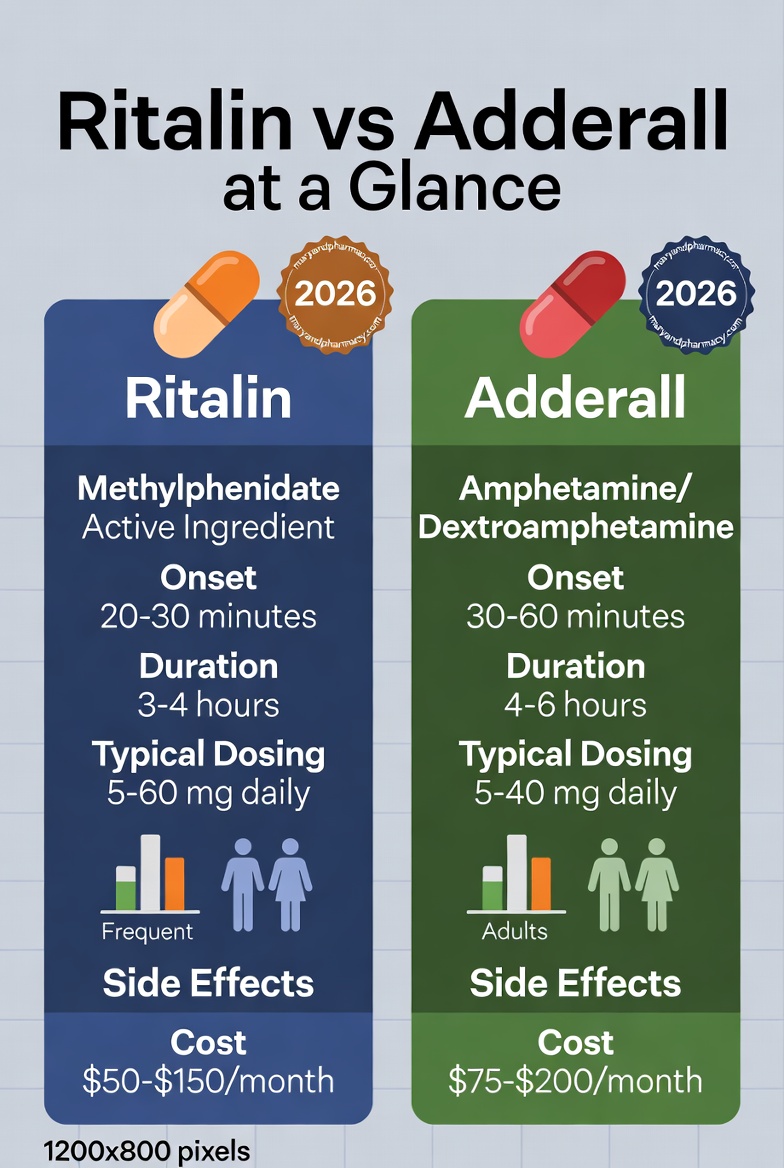
3. Head-to-Head Comparison Table
| Feature | Ritalin (Methylphenidate) | Adderall (Mixed Amphetamine Salts) | Winner for Most People? |
|---|---|---|---|
| Active Ingredient | Methylphenidate HCl | Amphetamine + Dextroamphetamine | — |
| Mechanism | Blocks reuptake only | Blocks reuptake + promotes release | Adderall (stronger boost) |
| Onset of Action | 20–60 minutes | 30–60 minutes | Ritalin |
| Duration (IR) | 3–5 hours | 4–6 hours | Adderall |
| Duration (XR/LA) | 6–12 hours | 10–12 hours | Adderall |
| Common Forms | IR tablets, LA capsules, SR, patches, liquid | IR tablets, XR capsules | Ritalin (more options) |
| 2026 GoodRx Cost (30-day generic) | $19.86 – $51 | $16.99 – $45 | Tie (both very affordable) |
| Best For (Age) | Children & adolescents | Adults | Age-dependent |
| Abuse Potential | Schedule II (high) | Schedule II (slightly higher street value) | Ritalin (marginally lower) |
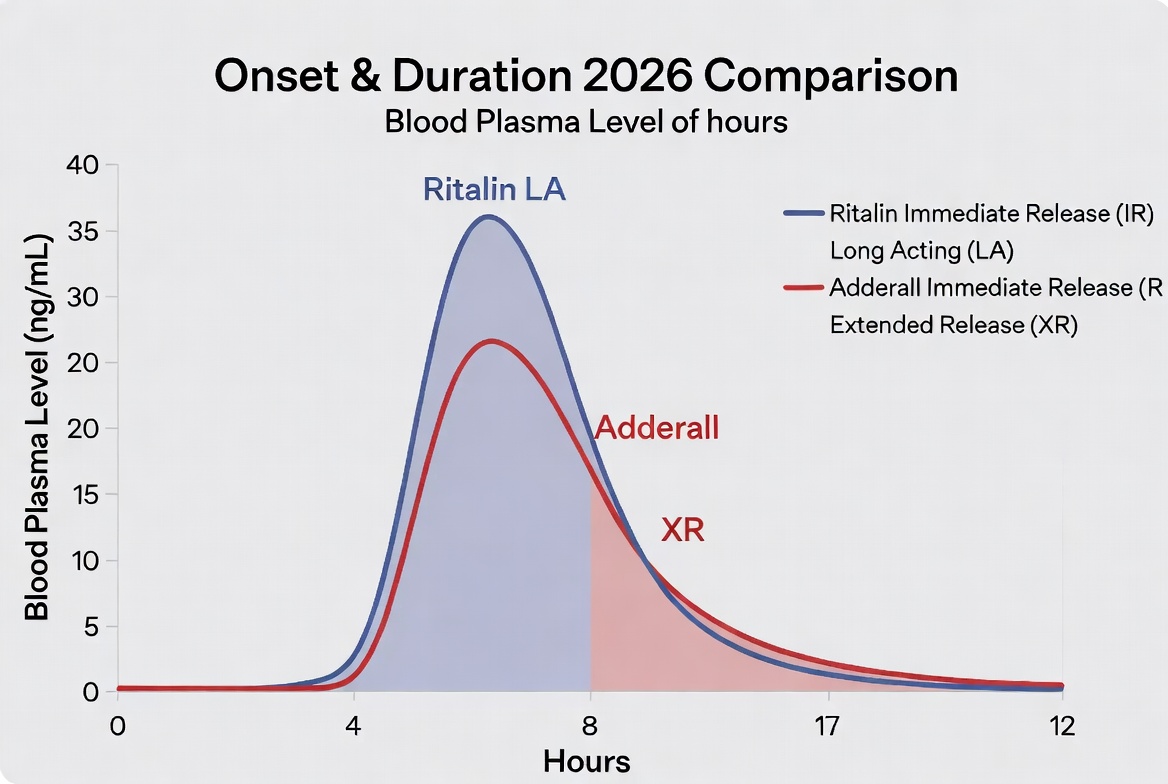
4. Onset & Duration (with timeline graphic placeholder)
Visual to create: Horizontal timeline infographic showing blood-level curves (Ritalin peaks fast & drops; Adderall has smoother, longer tail).
- Ritalin IR: Works in 20–60 min, peaks ~2 hrs, gone by 3–5 hrs.
- Ritalin LA/SR: 6–8 hrs coverage.
- Adderall IR: 30–60 min onset, lasts 4–6 hrs.
- Adderall XR: 10–12 hrs (some report up to 14 hrs).
Pro tip: If you need all-day coverage without multiple doses, Adderall XR wins. If you want flexibility or a quick “boost” for mornings, Ritalin IR/LA is easier to titrate.
5. Forms & Dosing Schedules
Ritalin offers more variety (IR, LA, SR, patch, liquid in some generics). Adderall is simpler: IR or XR.
Dosing is highly individualized — start low, titrate every 1–2 weeks under medical supervision.
6. Effectiveness by Age Group (kids vs adults vs college students)
- Children & adolescents: 2018–2025 meta-analyses (including 2025 updates) show methylphenidate (Ritalin family) has the best efficacy/tolerability balance.
- Adults: Amphetamines (Adderall family) edge out slightly in symptom reduction and quality-of-life scores.
- College students: Adderall XR often preferred for longer study sessions; Ritalin for shorter, flexible dosing.
Real-world note: ~50% of people respond equally to both; 25–30% do better on one class. Switching families is common and safe when done properly.
7. Side Effects Comparison (with severity scale)
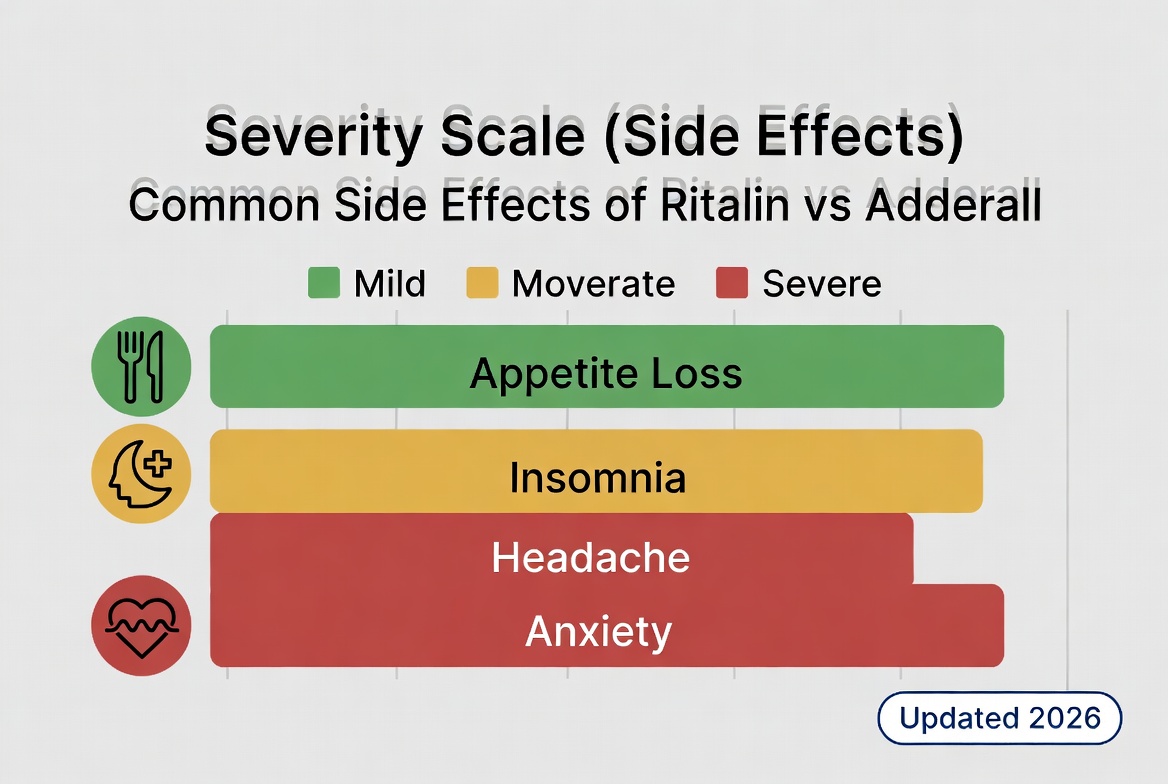
Common (mild–moderate, often improve over time)
- Both: Loss of appetite, insomnia, headache, dry mouth, anxiety, stomach upset, weight loss.
Ritalin-specific edge: Slightly higher stomach pain.
Adderall-specific edge: Slightly higher cardiovascular (fast heartbeat, BP rise) and irritability in some users.
Serious (rare, require immediate medical attention)
- Both: Heart palpitations, mood swings, tics, hallucinations (high doses).
- 2025 FAERS analysis: Both have psychiatric signals; amphetamines show stronger cardiovascular signals in some cohorts.
Severity scale graphic placeholder: Color-coded bar chart (green = mild, yellow = moderate, red = monitor).
8. Drug Interactions & Safety
Major interactions (avoid): MAOIs, certain antidepressants, caffeine in excess.
Monitoring needed: Blood pressure, heart rate, growth in kids, sleep, appetite.
Both are pregnancy Category C — discuss with OB/GYN. Long-term safety data (2024–2025 studies) show reduced psychiatric hospitalizations and suicidal behavior with proper use.
9. Cost & Insurance (2026 prices + GoodRx alternatives)
Cost is a key factor when choosing between Ritalin and Adderall. Both have affordable generics in 2026.
Current GoodRx Pricing (March 2026):
- Generic Ritalin / Methylphenidate (IR, LA, SR, ER forms): As low as $19.86 – $55 for a 30-day supply (up to 91% off retail).
- Generic Adderall / Amphetamine salts (IR & XR): As low as $16.99 – $45 for a 30-day supply (up to 95% off retail).
Brand-name versions are much higher: $200–$800+ per month without discounts.
Most insurance plans cover generics, but some 2026 BCBS plans have moved Adderall to higher tiers, raising out-of-pocket costs.
Smart Savings Tips: Use GoodRx or SingleCare coupons, plus manufacturer cards when available.
For even better value and convenience, check Maryandpharmacy.com. We offer competitive pricing on ADHD stimulants with up to 50% discounts — for example, Adderall 20mg at $240 (from $480) and Adderall 30mg at $250 (from $500), plus Concerta at $150 (from $300). Enjoy fast local delivery in 24–48 hours and discreet service.
Browse our full ADHD Pills Online category to compare options and find the right formulation at affordable prices.
Note: Prices vary by dosage and location. Always consult your doctor and verify your prescription before purchasing.
10. Can You Switch or Take Both?
- Switching: Common and straightforward. Taper one while starting the other under doctor guidance. ~41% of new stimulant users switch families within 90 days due to tolerability.
- Taking both together: Not recommended. Moderate-to-major interaction risk (increased side effects, cardiovascular strain). Only in very rare, supervised cases.
11. Real Patient Experiences (anonymized + sourced)
- “Ritalin gave me laser focus, but I crashed hard at 3 pm. Switched to Adderall XR — smooth all day, but more appetite suppression.” (Reddit/ADDitude forums, 2025).
- “Adderall made my teen irritable; Ritalin LA was perfect for school + after-school activities.” (parent review, 2026). Individual results vary — track with a symptom journal.
How to Decide: Doctor Decision Tree
- Age & lifestyle? → Kids → try methylphenidate first. Adults → consider amphetamine.
- Need quick onset or all-day coverage?
- History of anxiety/heart issues?
- Insurance/cost?
- Trial & error (most people need 1–2 adjustments).
Talk to your doctor or psychiatrist today about whether Ritalin, Adderall, or another option fits your 2026 life.
FAQ
- What is the difference between Ritalin and Adderall?
Answer: Ritalin (methylphenidate) and Adderall (amphetamine and dextroamphetamine) are both stimulants used to treat ADHD. Ritalin works by blocking the reuptake of dopamine, while Adderall increases the release of dopamine and norepinephrine. - Which is better, Ritalin or Adderall?
Answer: The effectiveness of Ritalin vs Adderall varies depending on the individual. Ritalin may work better for short bursts of focus, while Adderall provides longer-lasting effects. Your doctor can help determine the best choice based on your needs. - Does Ritalin give you energy like Adderall?
Answer: While both Ritalin and Adderall increase dopamine levels to improve focus, Adderall is typically more stimulating and may give a stronger sense of energy compared to Ritalin. - Can Ritalin and Adderall be taken together?
Answer: No, taking both Ritalin and Adderall together is not recommended due to the risk of severe side effects. If one medication isn’t working, your doctor might suggest switching or adjusting the dosage. - Why do doctors prefer Adderall over Ritalin?
Answer: Adderall tends to be preferred by doctors because it has a longer-lasting effect, making it more convenient for adults who need symptom control throughout the day, whereas Ritalin’s effects are shorter-lived. - What is the 28-day rule for Adderall?
Answer: The 28-day rule refers to a limitation on how frequently Adderall prescriptions can be filled, due to its classification as a Schedule II controlled substance, intended to reduce the risk of misuse and dependency. - How long does Ritalin take to start working?
Answer: Ritalin generally takes between 20-60 minutes to start working, with its effects peaking within 1-2 hours. - Is Adderall or Ritalin better for adults?
Answer: Adderall is generally more effective for adults due to its longer-lasting effects, which are beneficial for maintaining focus and productivity throughout the day. - Can Ritalin cause anxiety?
Answer: Yes, one of the side effects of Ritalin can be anxiety, especially in those who are sensitive to stimulants. If this side effect occurs, a doctor may recommend adjusting the dose or switching medications. - How long do Adderall’s effects last?
Answer: The effects of Adderall can last 4-6 hours for the immediate-release (IR) form and up to 12-16 hours for the extended-release (ER) form. - What are the side effects of Ritalin?
Answer: Common side effects of Ritalin include insomnia, decreased appetite, weight loss, and increased heart rate. More severe side effects like mood changes or blood pressure spikes can occur but are less frequent. - Can you take Ritalin with other medications?
Answer: Ritalin can interact with other medications, especially those that affect the heart rate, blood pressure, or serotonin levels. Always consult with your healthcare provider before combining it with other drugs.
Medical Reviewers:
- Jane Thompson, PharmD, BCPS (15+ years in psychopharmacology)
- Michael Rivera, MD, Board-Certified Psychiatrist (ADHD specialist)
References:
- Cortese S, et al. Comparative efficacy and tolerability of medications for attention-deficit hyperactivity disorder in children, adolescents, and adults: a systematic review and network meta-analysis. The Lancet Psychiatry. 2018. (Still the landmark study cited in 2025–2026 reviews).
- Faraone SV. The Pharmacology of Amphetamine and Methylphenidate. CNS Drugs. 2018 (PMC8063758).
- Oliva HNP, et al. Safety of Stimulants Across Patient Populations: A Meta-Analysis. JAMA Network Open. 2025.
- Bellato A, et al. Systematic Review and Meta-Analysis: Effects of ADHD Medications on Quality of Life. Journal of the American Academy of Child & Adolescent Psychiatry. 2025.
- FDA Drug Safety Communication: Expanded labeling about weight loss risk in patients younger than 6 years taking extended-release stimulants for ADHD. July 2025.
- GoodRx. Methylphenidate Prices, Coupons & Savings Tips (2026 data).
- GoodRx. Adderall (Amphetamine Salt Combo) Prices (2026 data). opened
- Kay B, et al. ADHD drugs may work indirectly to boost attention via arousal and motivation networks. Cell. 2025 (Washington University study).
- Man KKC, et al. Long-term safety of methylphenidate in children and adolescents. The Lancet Child & Adolescent Health. 2023.
- Zhang L, et al. Attention-deficit/hyperactivity disorder medications and long-term risk of cardiovascular diseases. JAMA Psychiatry. 2024.
- Childress AC. Novel Formulations of ADHD Medications: Stimulant Update. Focus. 2021.
- Ostinelli EG, et al. Comparative efficacy and acceptability of treatments for ADHD: a systematic review and component network meta-analysis. The Lancet Psychiatry. 2025.
- Vasiliadis HM, et al. ADHD medications use and risk of mortality and unintentional injuries. Translational Psychiatry. 2024.
- Rzeszutek M, et al. Global Trends in ADHD Medication Use. Journal of Clinical Medicine. 2025.
- FDA. Updates to clarify labeling of prescription stimulants used to treat ADHD (2023 baseline, referenced in 2025 updates).